Galleria Ama | 2026
Kaisaleena Halinen
Mourning
9.1.20216-1.2.2026
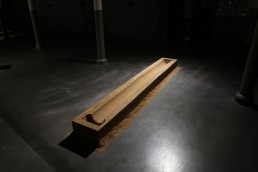
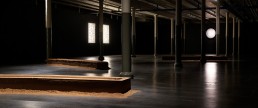
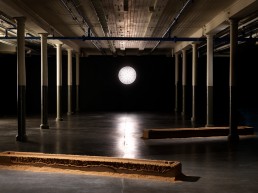
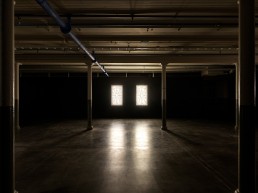
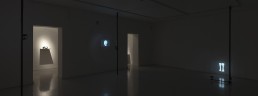
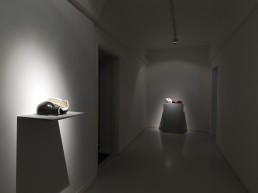
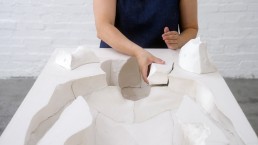
Layer by layer, piece by piece, a human being is created and formed. In the same way, we also depart—piece by piece, layer by layer. For a moment we exist in candle flames, in fragrant beeswax, in thin smoke. Fragments of our existence remain in the thoughts of the living, in photographs, and on gravestones. Movement is continuous as great gates are opened and closed. Do we exist only as long as we are remembered?
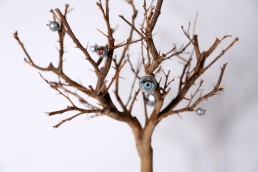
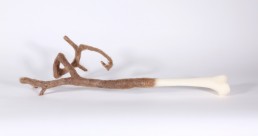
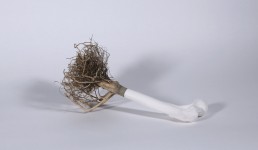
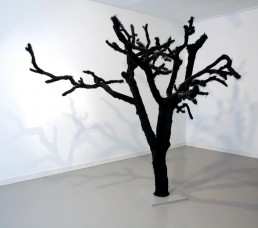
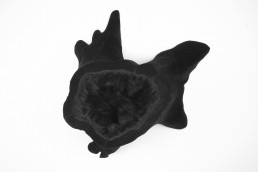
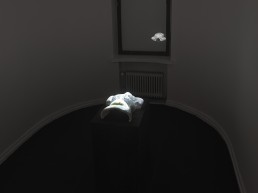
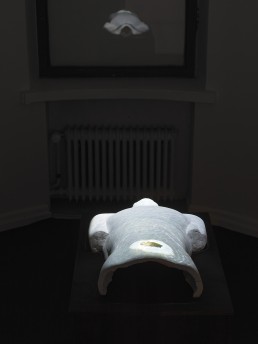
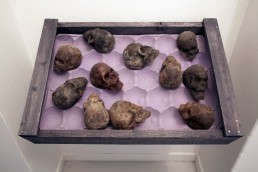
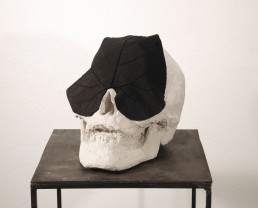
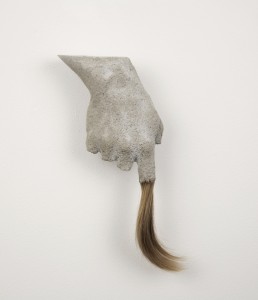
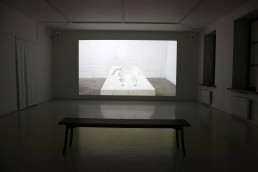
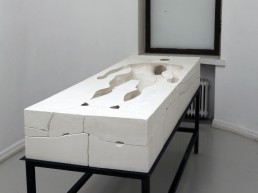
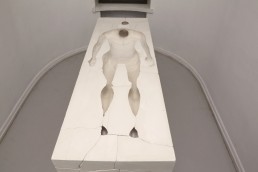
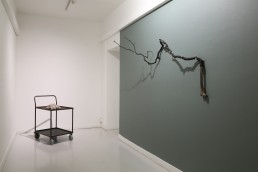
The works in Kaisaleena Halinen’s new exhibition are dominated by elements of existence and transience. One of her starting points has been Hans Holbein the Younger’s painting Der tote Christus im Grab (The Dead Christ in the Tomb, 1521–1522). It is a painting that deeply unsettled Fyodor Dostoevsky when he visited the Basel Art Museum in 1867. Measuring two meters in width and thirty and a half centimetres in height, the work is disconcerting already by its proportions alone. Dostoevsky’s wife, Anna Grigorievna, wrote in her memoirs about her husband’s reaction before the painting: “He stood motionless for twenty minutes, and it was evidently difficult for him to control himself. His agitated expression foretold the onset of an epileptic seizure.” Dostoevsky returned to the painting in his novel The Idiot, where Prince Myshkin exclaims upon seeing the work: “That painting could make some people lose their faith.” Holbein’s painting is realized at the intersection of the experience of human death, the inexorable laws of nature, and Christianity. In a similar way, different elements intersect in Kaisaleena Halinen’s works. Bone and charred wood have grown together. In decomposing, slowly vanishing parts of organisms, ice-like, glass berries grow—signs of living matter. Calla lilies, the stately flowers of death, formed from ash, travel in their black carts. In the reliefs, candles burn; memories, thoughts, and prayers for the absent are embedded in plaster and beeswax.
Every grief is different, every loss and longing forms its own universe. We are built as much from what is unattainable as from what has been attained. We are shaped by losses, renunciations, and yearning. When a person—someone we may at times have taken for granted as ordinary—leaves us, they become ever-present. Gradually, our memory constructs its own story of them, shaping them from fragments and parts that may be true. True or not, the human figure remains.
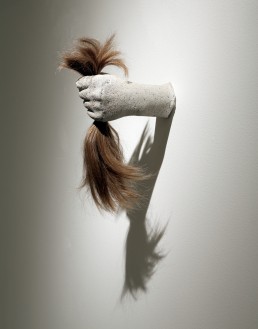
If Holbein’s painted dead Christ, through his humanity, caused someone to doubt his divinity, are we capable of seeing divinity in the humanity of the deceased? I cannot say. I do not know the answer. The Hungarian writer Imre Kertész wrote: “The only path to freedom passes through memory.” In Kaisaleena Halinen’s works, the gates of memory are slightly opened. Each of us builds our own memories until it is others’ turn. Then we become a trace in time, an imprint in plaster. Let us hope that at that moment gentle hands will carry us.
Hannu-Pekka Björkman
actor–writer
Ama Gallery | Helsinki | 2026
Kaisaleena Halinen
Mourning
9.1.20216-1.2.2026
Kerros kerrokselta, pala palalta syntyy ja muodostuu ihminen. Samalla tavoin hän myös poistuu, pala palalta, kerros kerrokselta. Hetken olemme kynttilän liekeissä, tuoksuvassa mehiläisvahassa, ohuessa savussa. Elävien ajatuksissa, valokuvissa ja hautakivissä säilyvät fragmentit olemassaolostamme. Liike on jatkuvaa, kun suuria portteja avataan ja suljetaan. Olemmeko olemassa, vain niin kauan kuin meidät muistetaan?
Kaisaleena Halisen uuden näyttelyn teoksia hallitsevat olemassaolon ja katoavaisuuden elementit. Eräänä lähtökohtana on toiminut Hans Holbein nuoremman maalaus ”Der tote Christus in Grab – Kuollut Kristus haudassaan (1521-1522).” Se on maalaus, joka järkytti syvästi Fjodor Dostojevskia hänen vieraillessaan Baselin taidemuseossa 1867. Kaksi metriä leveä ja kolmekymmentä ja puoli senttiä korkea teos on jo mitoiltaan hämmentävä. Dostojevskin vaimo Anna Grigorijevna kirjoitti muistelmissaan miehensä reaktiosta maalauksen edessä: ”Hän seisoi kaksikymmentä minuuttia liikkumatta paikallaan ja hänen oli ilmeisen vaikeaa hillitä itseään. Hänen kiihtynyt ilmeensä enteili epilepsiakohtauksen alkua.” Dostojevski palasi maalaukseen Idiootti romaanissaan, jossa ruhtinas Myskin huudahtaa teoksen nähdessään: ”Tuon maalauksen takia moni saattaa menettää uskonsa.” Holbeinin maalaus todentuu inhimillisen kuoleman kokemuksen, vääjäämättömien luonnonlakien ja kristinuskon risteyksessä. Samalla tavoin risteytyvät eri elementit Kaisaleena Halisen teoksissa. Luu ja hiiltynyt puu ovat kasvaneet yhteen. Maatuvissa, hitaasti häviävissä organismin osasissa kasvavat jäiset, lasiset marjat. Elävän aineen tunnusmerkit. Kallat ylväät kuolemankukat kimppuna, tuhkasta muotoiltuna, matkaavat mustissa kärryissään. Reliefeissä palavat tuohukset, kipsiin ja mehiläisvahaan uponneet muistot, ajatukset ja rukoukset poissaoleville.
Jokainen suru on erilainen, jokainen menetys ja kaipuu on oma universuminsa. Rakennumme saavuttamattomasta yhtä paljon kuin saavutetusta. Rakennumme menetyksistä, luopumisista ja kaipuusta. Kun ihminen, jota ehkä pidimme aika ajoin itsestäänselvyytenä ja arkisena, poistuu luotamme, hän tulee alati läsnä olevaksi. Vähitellen muistimme rakentaa hänestä oman tarinansa. Muotoilee hänet palasista ja osista, jotka ovat ehkä totta. Totta tai ei, ihmisen hahmo säilyy.
Jos Holbeinin maalaama kuollut Kristus sai inhimillisyydellään jonkun epäilemään hänen jumaluuttaan, kykenemmekö me näkemään jumaluuden edesmenneiden inhimillisyydessä. En osaa sanoa, en tiedä vastausta. Unkarilainen kirjailija Imre Kertész kirjoitti: ”Ainoa tie vapauteen kulkee muistin kautta.” Kaisaleena Halisen teoksissa muistin portit raottuvat. Ihminen rakentaa muistojaan, kunnes tulee toisten vuoro. Silloin olemme vain jälki ajassa, painauma kipsissä. Toivokaamme, että meitä kannattelevat tuolloin hellät kädet.
Hannu-Pekka Björkman
näyttelijä-kirjailija
Galleria Himmelblau | 2023
Gallery Himmelblau| Tampere | 2023
Symbioses and paradoxes
Kaisaleena Halinen’s exhibition is spread across two spaces at the Himmelblau Gallery. The works in the old cotton hall draw inspiration from the history of the Finlayson mill. The hall is filled with a soundscape created in collaboration with Jani-Matti Salo that is based on a recording made onsite at the mill by the Finnish Broadcasting Company in 1990. In its day, the mill was its own miniature community that exerted a powerful formative influence on the identity of its members. The mill provided work and income, but the workers in turn endured heavy labour, long hours, and exposure to deafening industrial noise.
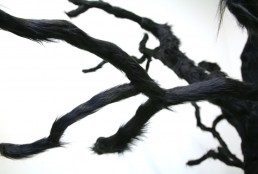
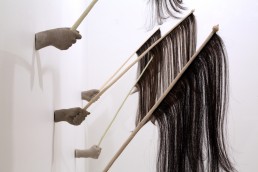
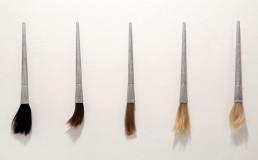
If the factory left an indelible mark on the workers, so too did they leave traces of their presence visible in the mill’s structures. The artist lyrically accentuates these human traces in her window grills made of human hair fibres that she has spun and carded the traditional way. The same methods were once used at the mill, albeit in mechanized form. The hair-woven window grills embody the symbiotic relationship between the mill and its workers.
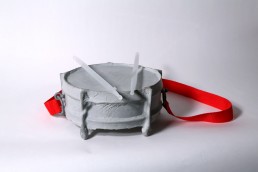
Halinen is intrigued not only by symbioses, but also by paradoxes. The questions she raises in the old cotton hall are reprised in the exhibits in the main gallery. Her blurring of the line between the logical and illogical comes to light strikingly in Concrete Drum. A concrete drum cannot resonate sound, and it would be futile to strike it with glass drumsticks. Such paradoxes can visualize the thorny complexities of our reality. There are no easy answers, and going to extremes only undermines the force of one’s message.
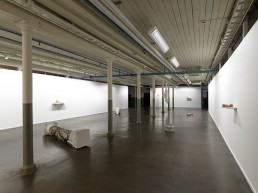
The most engaging feature of Halinen’s art is its nuanced power of suggestion. Her ambiguous pillar pieces for instance evoke associations with human civilization and society’s support structures, but their organic allusions expand the horizon of interpretation in a different direction, invoking the vulnerability of nature. Through subtle symbioses and the marriage of seemingly incompatible elements, Halinen activates the viewer’s own memory webs, thus offering a reflective surface that mirrors our surrounding reality. Halinen eschews facile generalizations and spurious either-or logic of the kind that too often brings social debate to a grinding halt.
Tomi Moisio, PhD, art historian
Galleria Kone | 2021
Gallery Kone | Hämeenlinna | 2021
Kaisaleena Halinen
He eivät tiedä mitä tekevät
1.5.2021-25.5.2021
Työhuoneellani on erilaisten kokeilujen jäljiltä teosten osia
rikki menneiden teosten palasia
epäonnistuneita valuja
löydettyjä rikkinäisiä esineitä ja kappaleita.
Ne ovat kiehtovia, mutten vielä tiedä miksi.
Ne ovat esillä, jotten unohtaisi, mutta hieman syrjässä, etten ajattelisi liikaa.
Pidän työvaiheista
muoteista,
laatoista,
valuista,
prosesseista, joita voi kontrolloida, mutta joissa saattaa tapahtua jotakin odottamatonta ja sattumanvaraista.
Yleensä pahimpia epäonnistumisia seuraavat parhaimmat ideat.
Joskus pohdin teenkö tahallani virheitä, jotta tapahtuisi jotakin yllättävää.
Minulle materiaalit ovat tärkeitä ja rakkaita, yritän ymmärtää niiden käyttäytymistä omilla epätieteellisillä tutkimuksillani. Toisinaan ajattelen materiaalia työparinani, henkilönä, jonka kanssa teen töitä ja keskustelen. Yritän oppia materiaalin käyttäytymistä, mutten saa hallita liikaa, aivan kuten ihmissuhteissakin.
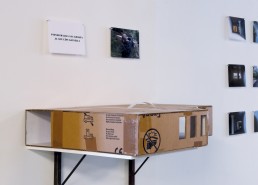
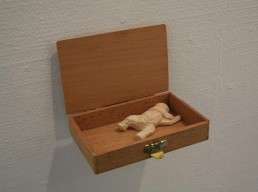
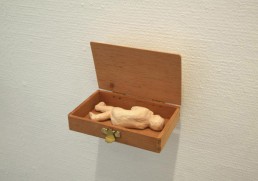
He eivät tiedä mitä tekevät on Jussi Valtosen romaanin nimi, mutta se on myös lause, joka on ollut mielessäni, kun ajattelen Riihimäen wanhan lasitehtaan kesänäyttelyä 2019. Näyttely jouduttiin sulkemaan ilkivallan takia, mikä on surullista. Itseltäni hajotettiin posliininen veistos, joka oli osana Pöytälaatikko-nimistä teosta.
Taiteilijana minua kiehtoivat kaikenlaiset ihmisen jättämät jäljet: lika, kulumat, halkeamat ja hajonneet patsaat. Vastavalmistuneena kuvataiteilijana parikymmentä vuotta sitten veistin marmorista uusia neniä nenättömille patsaille ja pari vuotta sitten pesin betonisten patsaiden kasvot siten, että ne menettivät inhimilliset piirteensä, tunnistettavat kasvonsa.
Annoin tälle näyttelylleni nimeksi ”He eivät tiedä mitä tekevät”, koska vaikka he tulivat hajottaneeksi teoksen, he eivät tienneet, että samalla he sysäsivät alulle ryppään uusia teoksia. Oli onni, että heidän kohdalleen sattui juuri minun veistokseni.
Galleria Ama | 2020
Gallery Ama | Helsinki | 2020
Kaisaleena Halinen: Sinelmä/Bruise 9.10.-1.11.2020
STRONG WORKS ABOUT FRAGILITY
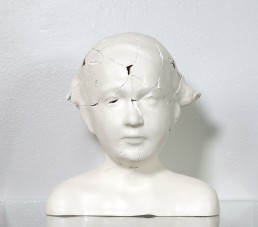
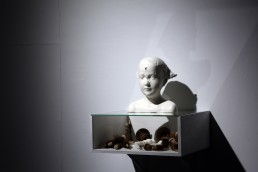
Kaisaleena Halinen has described the strong influence that a past incident has had on the works of the current exhibition. During the Summer Exhibition of 2019 in Riihimäki, somebody broke into the exhibition hall and demolished many of the works. A ceramic bust of a little girl had been shattered by a blow on the forehead. The artist only realized the violence and the weight of the act later when she was repairing the bust. Halinen decided to change her plans for the upcoming exhibition and put aside the works she had already started to work with. It felt more meaningful to let out the ideas that had started to emerge due to this broken and repaired bust.
The art of Kaisaleena Halinen is delicate and fragile, but it arouses strong, intimate sensations. In the current exhibition in Galleria Ama, Halinen continues with her deep, profound reflection on humanity, power, violence, fragility and shame. Changes in the fragile surface of the delicate ceramic sculptures evoke, through connotations, strong and almost physical sentiments.
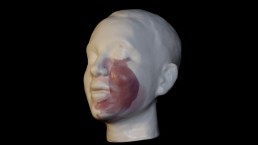
In a video work called Sinelmä/Bruise, a reddish patch resembling a bruise starts to emerge in a cheek of ceramic head of a woman. In a viewer’s mind, it conjures up images of domestic violence, oppression and control over others. When the patch spreads, you start to notice cracks, net-like craquelures, on the ceramic surface. The paradoxical beauty of the hairline fractures reinforce the sense of threat and malice.
Halinen uses these fractured surfaces, produced by a matt white craquelé glaze, as an effect also in many other works of this exhibition. The closed eyelids of the piece called Näkijä/Seer are covered with a network of hairline fractures. The lips of the adjacent heads in Requiem are cracked. Human life and human relationships are brittle, fragile and shattered. The ceramic heads become associated with death masks. The surface of some of the sculptures is treated in part with ink, that makes the hairline fractures stand out. This conjures up an image of a subcutaneous, self-determining and otherwise invisible energy.
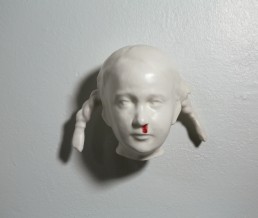
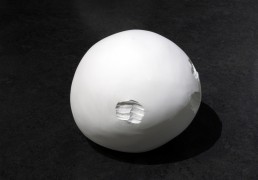
Halinen has examined the ways ceramics behave, for example, by filling a hollow cast head with water (Waves), and by soaking ceramic feet in water containing ink and coffee (Herkistyminen/Sensitization). The feet absorb water and darken. These changes Halinen has recorded in her videos. In the gallery, the three videos are projected each on their own wall. The realistic effect is increased by the fact that the objects are life-size: the feet are the size of human feet, the head is the size of a human head. The impression of blushing in a piece called Waves has been achieved by first adding a small amount of red pigment to the casting slip. When the burnt sculpture gets wet, it turns darker and ”blushes”. The hollow sculpture has been filled with water when upside down, so blushing seems to rise from the inside.
In the video piece Sinelmä/Bruise, where a bruise emerges on a woman’s face, it starts as red and very small but expands and turns bluish. Some inks can penetrate a ceramic surface and colour it. The ceramic material lets through the red colour in the ink first, and after that, the blue.
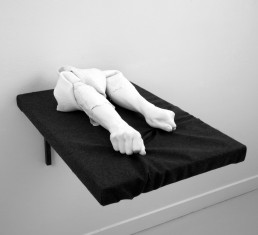
In a small back room of the gallery, there is a torso of a man lying on a low pedestal. A video of a stone being thrown through thin ice is projected on the torso. The ice appears to form a skin on the torso, which is then broken by the stone. From under the ice, water wells up like blood or some other bodily fluid. The sound of the breaking ice accentuates a feeling of pain and agony.
In the field of art in Finland, there is a lively debate going on about the meaning of art and its purpose. Should art be used for making a statement or should it keep to its own values? In a critics’ journal, Kritiikin uutiset, Olli Ahlroos writes about experiencing art and being touched by art. He says: ”Experiencing art is a rare and improbable event that takes place in the presence of exceptional works of art.”
Ahlroos is referring to the thinking of Gilles Deleuze, for whom great art is political. For Deleuze the political nature of art does not depend on the artist’s political views but it is a question of quality. ”A great work of art is political, because, according to Deleuze, that is what an act of creating by definition is. An artist should create, not ‘reflect’ reality or convey reactive ‘information’”. Creating something new is political, because it forces something unprecedented and uncontrollable on the surface of an artwork, on its structures and on the surrounding reality. A creative act opens, by way of the surface of the artwork and through it, a possibility to experience something, that the existing political parties and ideologies cannot bring under control in their system. Only creating something uncontrollable is ”an act of resistance” according to Deleuze.”[1]
Experiencing art is a rare and improbable event that takes place in the presence of exceptional works of art. This kind of event can be experienced looking at the works of Kaisaleena Halinen.
Marja Sakari
PhD, Director of Ateneum Art Museum
——
[1] https://www.kritiikinuutiset.fi/2019/12/15/kasittamaton-taide-osa-2-luomistekojen-etiikasta/?fbclid=IwAR1Q_u1AvKol4jPwYmD8FxKI0KTJrFgUey9MyF2mCYu4OL_ekHB4eCah1fw
Forum Box | 2018
Gallery Forum Box | Helsinki | 2018
Kaisaleena Halinen: Pro et contra 4.5 – 27.5.2018
From May 4th until May 27th Forum Box presents visual artist Kaisaleena Halinen’s exhibition Pro et contra. The exhibition will be Halinen’s most extensive solo exhibition up to date.
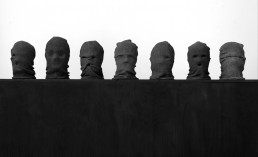
In the exhibition Pro et contra the viewer encounters different figures, or human-like pieces, which all have something to tell or something to hide. The pieces consist of concealed stories or referential statements. We recognise feminine attributes in the figures, but they are concealed or hidden. We can identify even violent attempts to efface the feminine. Kaisaleena Halinen offers the viewer riddles and various questions. Face and identity are the focal points of many of the works. The faces are either purposefully covered or the figure’s face has been bereaved from them, such as in the piece Kasvonsa menettäneet, where the artist washes the features of the molded concrete heads. When your characteristics, and by that note, your identity, are being effaced: what will be left?
The exhibition title piece, Pro et contra, is depicting a row of figures wearing commando beanies in the Permanto space. The figures block the space and demand the viewer to take their place. The viewer has to decide: will they stand by or against the anonymous crowd. The viewer cannot bypass the demand and there are no options: the mere existence of the viewer places them either pro or counter. But pro and counter what?
Jacques Rancière, one of the most remarkable contemporary philosophers of our time, states that art, like politics, is primarily about dissensus (Le Dissensus); the disagreement and the struggle concerning our shared world’s limitations. Rancière states that art has political capacity, because it makes visible and redefines the inaudible and agents that are positioned outside of the mutually defined.
Art reconfigures the distribution of the sensible. It challenges established, pre-defined positions, and reconfigures the limits of the perceivable world. In doing so, it creates possibilities for new voices and agents. It poses the question: who has the right to speak and act and who will be left with a passive role and mute. Whatever your position, it is always in relation to other agents.
In her exhibition Pro et contra, artist Halinen creates multidimensional and intricate references to the contemporary social atmosphere, while skillfully commenting on history writing, art history and the construction of narratives.
-Nina Toppila, Art Historian MFA
The exhibition has been supported by Finnish Cultural Foundation and Arts Promotion Centre Finland.
Galleria Huuto | Jätkäsaari 1 | 2014
Galleria Huuto | Jätkäsaari 1, Helsinki | 2014
An installation and peeking perspectives
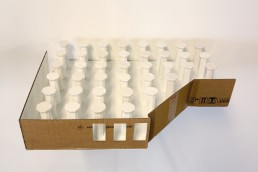
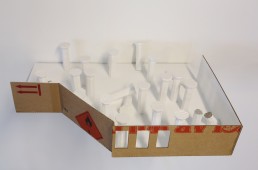
It all began from a space, a plan, a scale model.
By building a scale model the space is transferred to my mind and for the following months I will keep the space with me. I built a portable scale model, it is like a symbol of this time.
I create more scale models, I experiment with them and think about spatial solutions.
The scale models include moments that I have decided to show at Galleria Huuto.
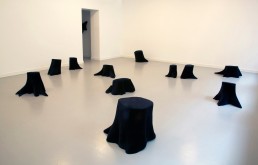
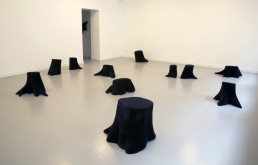
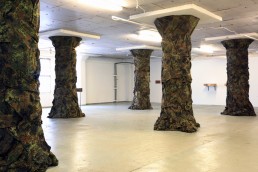
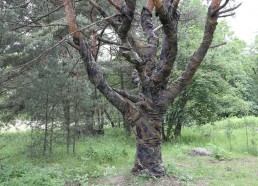
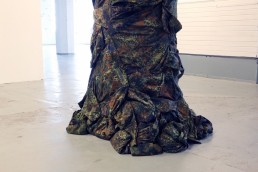
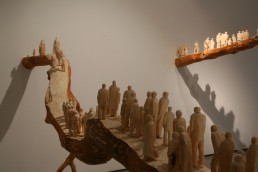
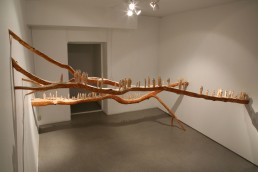
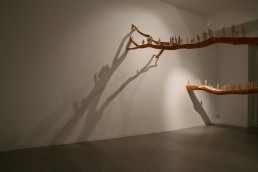
Pillars are troops that form an army, like a unit on standby. Trees are units that form a forest.
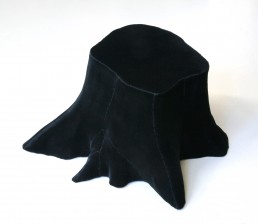
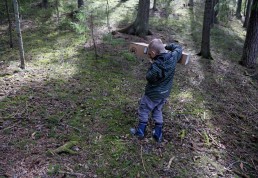
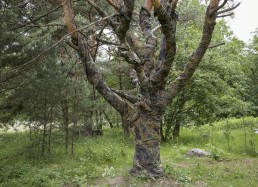
Trees inspire awe as they remain in their place for centuries, growing from a seed into a strong tree, increasing their height and the number of growth rings. Growing takes years, but a tree can be cut down in no time. Real trees have been covered in the photographs using camouflage fabric, disguised so that the trees cannot be seen for the forest.
In the gallery a pillar is a tree,
a group of masks
a forest.
Galleria Huuto | Uudenmaankatu | 2008
I felt an urge to portray the human being and to carve wood. This was a brand new situation, as I usually have an idea, and the idea then finds a means and material. My previous works, too, have dealt with the human being or humanity – however, this has happened through absence, such as with traces, wear and tear, or dirt. This time, I wanted to sculpt concrete human figures.
I decided to work by instinct and see what the figures will be like, and how they will be related to each other. During the sculpting process, I took each figure as an individual, but the group formed by the individuals became the most important element. In the final works, the figures have settled in a group portrait, where rest enables humans to make space for themselves.
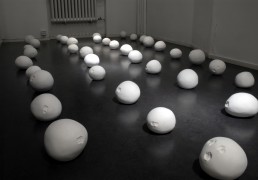
The last work for the exhibition at Galleria Huuto was an installation consisting of plaster sculptures in which a crop has been destroyed by a plague. After finishing the work, I realized I had returned to traces.